AI Workflow Redesign

Your team has AI tools, but no one can say where they have changed how the work gets done. We help you find out, and redesign the work where it should change.

If the workflow stays the same, an AI rollout tends to produce activity rather than better work. We look at how the work actually runs, find which workflows, decisions, and handoffs between people and AI should change, redesign them, and leave your team written guidance it can follow on its own.

Building an AI-enabled product instead? See AI-Enabled Product Research →

One first step: a conversation.

  1. Start here

    Discovery conversation

    A free 30-minute call about your current AI situation: what is in place, where it is working, where it isn't, and what you are trying to accomplish. We recommend a first engagement, or tell you honestly if we are not the right fit.

    Discuss your AI adoption challenge →
  2. First paid step

    Executive Brief or 2-Week Diagnostic

    Which one depends on what you need: a written recommendation from one session, or a mapped and prioritized look at one function or team. Compare them

  3. Then

    4-Week Performance Sprint

    Redesigns one or two priority workflows, pilots them with your team, and hands over written guidance for running them.

  4. When needed

    Build & Implementation

    Engineers the integrations, automation, or custom tools a proven workflow needs.

Not ready to talk yet? The AI Adoption Readiness Scorecard is a self-assessment you can take on your own (free score, full report $49). Also available at any point: Tailored AI Workshops and a Private AI Coaching Intensive. Details on every engagement are in the engagement path below.

Executive Brief or 2-Week Diagnostic?

Neither is a required starting point, and neither depends on the other. We will suggest one on the discovery call based on what you tell us.

Executive Brief

Who it is for
Leaders who want a written, outside recommendation on where to focus before committing to a larger engagement.
What it is
One paid, fixed-scope working session. We review the gap you are seeing in how work gets done and identify your highest-value opportunities.
What you receive
A written memo naming those opportunities and a recommended next step.
Already decided? Book the Executive Brief directly →

2-Week Diagnostic

Who it is for
Organizations that know which function or team they want examined and want a prioritized plan for it.
What it is
Two weeks of user research and workflow analysis across the workflows inside one function or team. It is analysis only, with no build, and it closes with an executive readout.
What you receive
A prioritized roadmap of where AI belongs in those workflows and where people's judgment should stay in charge, presented to leadership.
See the Diagnostic method →

The Problem:

For teams whose value depends on skilled judgment, the real AI risk is not replacement. It is gradual erosion.

AI can help teams move faster, but speed alone does not make the work better. When workflows are left as they were, teams can end up with uneven quality, heavy reliance on generic outputs, and less of the judgment and original thinking clients pay for.

It is rarely obvious at first. It shows up quietly: more revisions, work that looks polished but lacks judgment, clients questioning what they are paying for, and senior people spending more time fixing AI-assisted drafts.

Second Mind Solutions helps teams spot these patterns early and redesign the work so that AI handles the steps it does well, and people keep the review and judgment calls that matter.

And more capable AI will not reverse this on its own. Faster, smarter models can deepen the erosion instead of ending it. The problem was never the model. It was the way the work was designed around it.

Early studies point to the same risks when AI use is left unmanaged: clients may come to value routine expertise less, quality can become less predictable, and teams can drift toward more similar ideas. The answer is not less AI. It is better workflow design.

5%

Drop in earnings

AI-exposed freelancers saw a 5% earnings drop and 2% fewer contracts after new AI tools appeared.

Source: Brookings Institution, 2025

19 pct. points

Less likely to be correct

Consultants using AI were 19 percentage points less likely to solve a complex task outside AI's capability frontier.

Source: Harvard Business School

37/45

Drop in idea diversity

ChatGPT-assisted brainstorming showed significant drops in idea diversity in 37 of 45 statistical comparisons.

Source: Wharton Mack Institute / Nature Human Behaviour

These statistics do not prove that every team will face the same outcome. They point to a more practical risk: AI changes the economics, quality controls, and creative patterns of skilled work. Teams that redesign workflows around AI are better positioned to capture the upside without weakening the judgment, quality, and original thinking clients pay for.

The engagement path, in detail

Every engagement begins with a discovery conversation. From there, the Brief or the Diagnostic sets where to focus, the Sprint pilots the redesign on a live workflow, and Build engineers it when needed. Workshops and coaching stand on their own. Hover or tap any stop to see what's inside.

Sequential path Partner-engineered Standalone offering Progression Connects in anytime
After the call
Step 01EB
1 Session Executive Brief

One focused working session

Executive Brief

Method: paid, fixed-scope working session

A paid, fixed-scope working session for leaders who want a written recommendation before committing to more. We review the gap you are seeing in how work gets done, identify your highest-value opportunities, and deliver a written memo with a recommended next step.

What you get

  • A focused review of where the work is falling short
  • Highest-value opportunities, named
  • A written memo with a recommended next step
Book the Executive Brief
Step 022W
2 Weeks 2-Week Diagnostic

2 Weeks

2-Week Diagnostic

Method: UX research + workflow analysis

The 2-Week Diagnostic scopes to one function or team and looks across the workflows inside it. It identifies where AI is already changing how work gets done, where it is creating extra review or rework, and where redesign is most likely to help. It looks at workflows, tasks, review points, quality risks, handoffs, and pricing implications, then maps where AI use will help most and where people's judgment should stay in charge. Analysis only, no build. Closes with an executive readout.

The method: steps 01–06

  • 01Map the workflows as they actually run
  • 02Identify the tasks within each workflow
  • 03Isolate friction, judgment & information needs
  • 04Find the highest-value lever per task (AI first)
  • 05Define the specific AI applications to capture them
  • 06Prioritize by value, feasibility, risk & business measurability

Deliverable: a prioritized roadmap of where AI belongs and where judgment stays, presented to leadership.

Pilot it here
Step 034W
4 Weeks Performance Sprint

4 Weeks

4-Week Performance Sprint

Method: behavior-led system design

The 4-Week Performance Sprint turns the priority opportunities from the Diagnostic into redesigned workflows, practical AI usage patterns, review gates, and team-ready operating guidance. It is for firms that want to move past AI experimentation and start changing how work actually gets produced, reviewed, and delivered.

The method: runs 01–06, then adds 07

  • 01–06The full Diagnostic analysis, deepened on 1–2 workflows
  • 07Build the future-state workflow, pilot & guardrails

You leave with written guidance for the redesigned workflow, piloted on live work and ready for your team to run. It can extend to more workflows, or into Build & Implementation when the workflow needs engineering.

Scale it here
Step 04BI
4–10 Weeks Build & Implementation

Scoped per build · typically 4–10 weeks

Build & Implementation

Method: Second Mind design authority + partner engineering

Some redesigned workflows need more than prompts, templates, and review gates. They need tools connected to each other, repetitive steps automated, or a purpose-built internal AI tool. Build & Implementation turns the proven workflow into a working system. Second Mind writes the spec, sets the acceptance criteria, and stays accountable for the result. Vetted engineering partners do the build under our direction.

What gets built

  • Automations and integrations across the tools you already use
  • Custom internal AI tools and assistants trained on your standards
  • Agent-assisted workflows with human review gates built in
  • Measurement that ties the system back to your baseline

Usually follows the Diagnostic or Sprint. If you already know what needs building, we start with a short paid scoping phase.

Standalone · start anytime
~3 WksTW
Discovery → Design → Delivery Tailored AI Workshop

~3 Weeks · Discovery → Design → Delivery

Tailored AI Workshop

Method: scoped discovery + tailored facilitation

This is not generic prompt training. The workshop helps your team see where AI can support better work, where it creates risk, and how to use it without outsourcing judgment, creativity, or accountability. A short discovery session surfaces your real workflows first, then the session is built around them. Participants leave with clear principles for using AI inside real work, not just a list of tools or prompts.

What you get

  • Hands-on practice inside your own real workflows
  • Clear principles for where AI helps and where judgment must lead
  • Shared language leadership can reinforce afterward

Also available for keynotes and guest lectures. Download the one-pager (PDF).

Standalone · limited
4–6 WksPC
1-on-1 · Limited Availability Private Coaching Intensive

4–6 Weeks · Limited Availability

Private AI Coaching Intensive

Method: 1-on-1 coaching + behavioral skill-building

Private coaching helps executives, founders, and senior operators think through how AI should affect their workflows, staffing model, client delivery, quality standards, and market positioning. It is for leaders who want clearer thinking about the business implications of AI, not just help using the tools.

What you get

  • Fully tailored to your role and working style
  • Scope, structure and pace set with you
  • Pricing established case-by-case

A small number of seats open each quarter. Inquire at terence@secondmindsolutions.com.

Hover any stop to preview the engagement. On smaller screens, tap a stop to open its details.

From roadmap to running system

Most AI consultants stop at the recommendation. Most development shops start building before anyone has asked whether the workflow is right. Build & Implementation closes that gap. The same senior lead who diagnosed the work designs the system, directs the engineers, and signs off on whether it works for the people who have to use it and keeps review where judgment matters. Build is available to workflow clients and to product teams working with our product research practice.

Phase 01

Spec

We translate the redesigned workflow into a build specification: what the system does, where human judgment stays in control, what data it touches, and the acceptance criteria it has to meet.

Led by Second Mind
Phase 02

Build

Vetted engineering partners build against the spec. Second Mind runs weekly checkpoints, holds design authority, and keeps scope tied to the workflow, not to what is technically interesting.

Partner engineers, Second Mind directs
Phase 03

Prove

Your team tests the system inside real work, using the same user research methods behind our product research practice. We measure it against the baseline from the Diagnostic or Sprint and fix what does not hold up before anything is called done.

Led by Second Mind
Phase 04

Hand off

Documentation, a named internal owner, and a team session on how the system fits the playbook. Optional ongoing support is scoped separately, so you never pay for maintenance you do not need.

Second Mind + partner

What you get

  • One accountable lead from diagnosis through delivery
  • A fixed-scope, fixed-fee build tied to a measured workflow
  • Systems designed for adoption, not just capability
  • Full ownership of what is built, with documentation to match

What this is not

  • Not a software agency taking any build that comes in the door
  • Not automation for its own sake: every build traces to a workflow we have analyzed
  • Not a handoff to strangers: you work with Second Mind throughout
  • Not a replacement for your judgment: review gates stay where they belong

Engineering is delivered by a small bench of vetted technical partners under Second Mind's direction. You have one contract, one point of contact, and one lead accountable for the outcome.

Talk Through a Build

What this looks like in practice

Discuss your AI adoption challenge

AI Workflow & Adoption Diagnostic

Want the details on one page? The one-pager lays out what the 2-Week Diagnostic covers, how it connects to the Sprint, and what your organization walks away with.

Download the One-Pager

Frequently Asked Questions

What's the easiest way to get started?

Book a free 30-minute discovery conversation. We'll talk through your situation and, if there is a fit, recommend one paid first step: usually an Executive Brief (one working session and a written memo) or a 2-Week Diagnostic (a mapped and prioritized look at one function or team). See how they differ.

What size organizations do you work with?

Organizations of roughly 50 to 250 people where output quality and turnaround speed directly decide margins. We also take on bounded engagements with specific functions or teams inside larger organizations, where the scope is tied to a specific function or team rather than a full enterprise rollout.

Do you work remotely?

Yes. All of our engagements can be conducted fully remotely, and most clients prefer it. We've delivered consulting and training to teams in Bahrain, Los Angeles, and across the United States, entirely virtually and with no loss in quality or engagement.

What industries do you work in?

We are not tied to one industry. The methodology has been applied in creative services, telecommunications, nonprofits, and the public sector (including a 12-month enterprise AI study with the Commonwealth of Pennsylvania). Engagements are most effective wherever high-volume, high-stakes workflows exist: communications and marketing teams, operations and strategy functions, and organizations where output quality and speed are directly tied to business outcomes. If you're unsure whether your organization is a good fit, a complimentary discovery call is the quickest way to find out.

How is this different from AI tool training?

AI tool training teaches people how to use specific tools. Our work is different. We look at whether AI use is actually improving the work (its quality, its speed, and the thinking behind it) and redesign the workflow where it isn't. The goal is not fluency with a product. It is a clear, checkable change in how the work gets produced, reviewed, and delivered.

Do you build the tools yourselves?

Second Mind leads the design, the specification, and the acceptance testing. The engineering itself is done by a small bench of vetted technical partners working under our direction. You sign one contract, work with one lead, and never get handed off. This keeps the design accountable to your workflow and the people who run it, and it means you get engineers who build for a living rather than a consultant learning on your project.

We already know what we want built. Can we skip the Diagnostic?

Yes. Build & Implementation begins with a short, paid scoping phase that checks the workflow the system will live inside. Sometimes that confirms the plan. Sometimes it shows the real bottleneck sits one step earlier, which is far cheaper to learn before the build than after it.

What's the difference between the Sprint and Build & Implementation?

The Sprint redesigns one or two workflows and builds what your team can run directly: prompts, templates, lightweight tools, and review gates. Build & Implementation is for when the proven workflow needs engineering, such as connecting systems, automating steps, or creating a custom internal tool. Many clients do the Sprint first and move into a build only where the numbers justify it.

What happens on a discovery call?

Discovery calls are 30 minutes. We'll ask about your current AI situation: what's in place, where it's working, where it isn't, and what you're trying to accomplish. From there, we'll recommend the engagement that fits best, or tell you honestly if we're not the right fit. No pitch, no pressure.
Start with a conversation

A free 30-minute call about your team, your AI tools, and what is getting in the way. We'll recommend a first step, or tell you honestly if we're not the right fit. No pitch, no pressure.
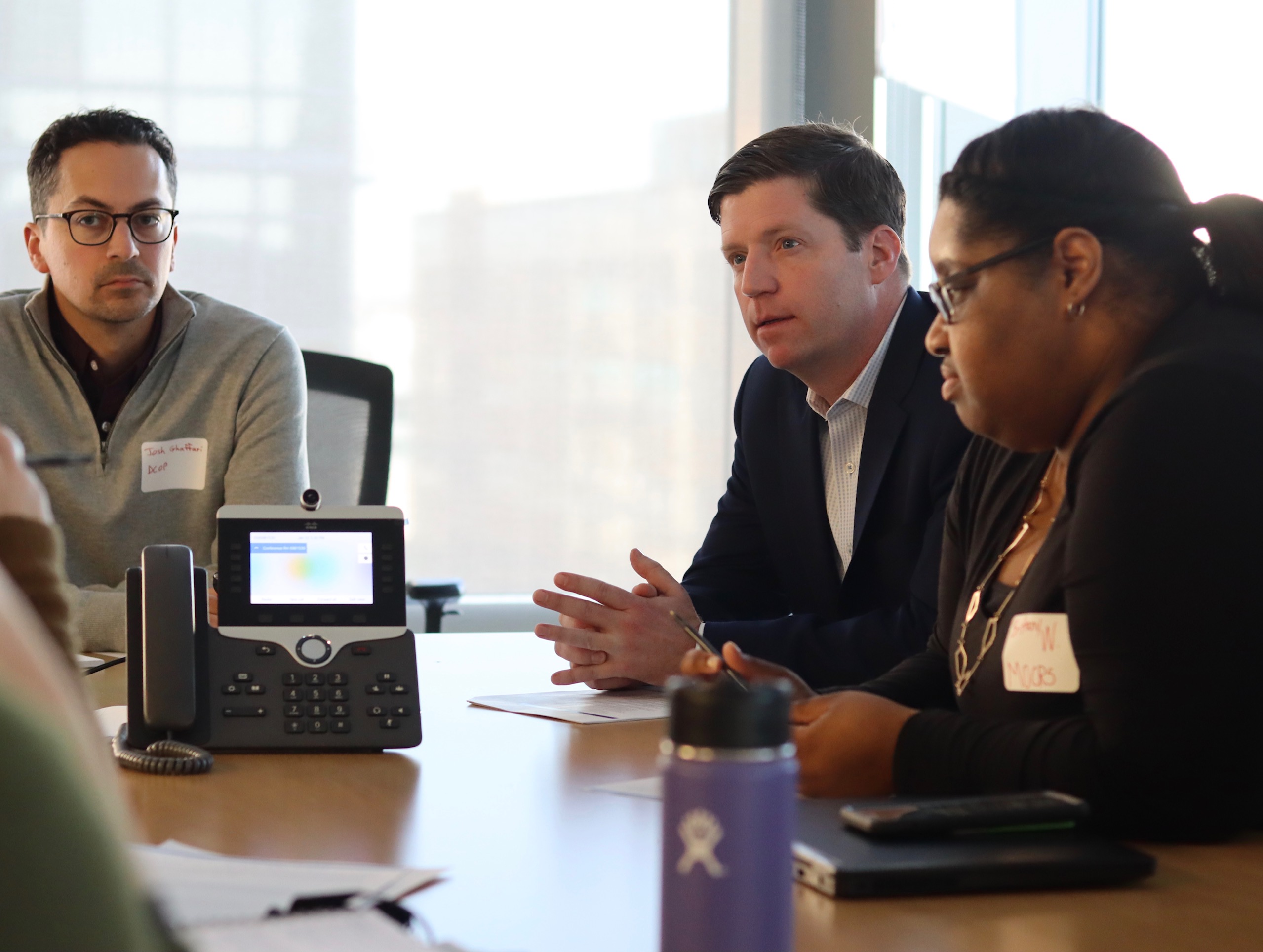
Discuss your AI adoption challenge

Building an AI-enabled product instead? See product research →